

To successfully identify a wasp nest in Maryland, look for its location and texture: paper wasps build open, umbrella-shaped paper combs under eaves; yellow jackets construct hidden, paper-covered nests underground or in wall cavities; and bald-faced hornets form large, gray, football-shaped hanging aerial nests.
Maryland’s climate supports a variety of stinging insects that become highly active from late spring through autumn.
Properly identifying these nests is essential for property safety, determining whether a species is aggressive, and deciding whether you can safely manage removal or need to call a professional pest control service.
This guide will break down the exact visual cues for Maryland’s most common wasp nests, explain how to tell them apart from beneficial bee hives, and help you determine the safest course of action for your home.
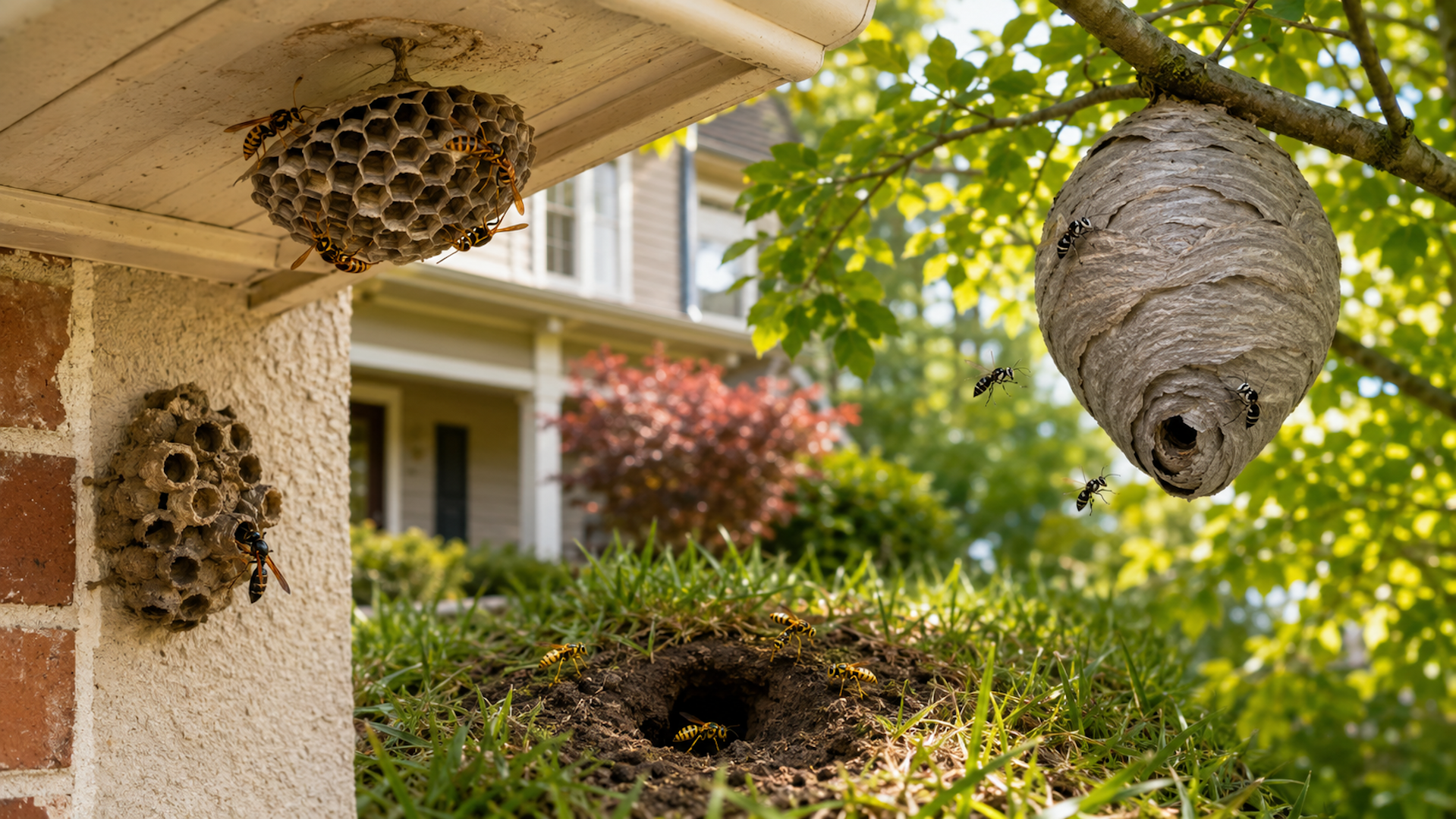
Paper Wasp Nest: What It Looks Like
A paper wasp nest looks like an open, upside-down umbrella consisting of a single, exposed papery comb with visible hexagonal cells.
Unlike those of other species, these nests are completely exposed and hang from a single, narrow stalk called a petiole.
Key identifying features include:
- Material: Gray or brownish-gray papery texture crafted from chewed wood fibers mixed with wasp saliva.
- Structure: Distinctive open-comb design with visible hexagonal brood cells.
- Attachment: Connected to surfaces by a single, durable anchor stalk (petiole).
- Size: Ranges from the size of a golf ball in early spring to a softball by peak autumn.
You will commonly find them tucked into eaves, porch ceilings, window frames, door casings, and outdoor light fixtures.
While paper wasps are generally less aggressive than yellow jackets, they will launch a coordinated defensive attack if their nest is disturbed.
A nest is active if you see adult wasps constantly landing on it or if you notice small white larvae tucked inside the open cells.
Yellow Jacket Nest: What It Looks Like
A yellow jacket nest can be either an enclosed, papery aerial structure or a completely hidden underground cavity, depending on the specific species.
Yellow jacket colonies can house thousands of aggressive workers by late summer, so identifying their nesting sites early is crucial for property safety.
Aerial Yellow Jacket Nests
Aerial yellow jackets build fully enclosed, dense structures that resemble a textured gray balloon or football.
- Appearance: A smooth, multi-layered gray papery shell that completely conceals the internal comb layers.
- Entrance: A single, small, and well-hidden entry hole located near the bottom of the structure.
- Common Locations: High-traffic areas like tree branches, dense shrubs, attic rafters, wall voids, and structural eaves.
Underground Yellow Jacket Nests
Underground yellow jacket nests are highly dangerous because they lack a visible outer structure and are incredibly difficult to spot until stepped on.
Their nests are usually a small, inconspicuous hole directly in the soil or lawn.
Lawnmower vibrations or foot traffic can trigger an immediate, massive swarm attack. Never probe or attempt to flood a ground hole yourself.
Bald-Faced Hornet Nest: What It Looks Like
A bald-faced hornet nest is a large, gray, football-shaped structure constructed from chewed wood pulp.
While technically a member of the yellow jacket family, the bald-faced hornet (Dolichovespula maculata) exclusively builds massive, dramatic aerial nests on the exterior of structures and trees.
Key identifying features include:
- Gray papery football-shaped structure
- Completely enclosed outer shell
- One main entry hole near the bottom
- Size ranging from softball to basketball-sized or larger by late summer
These nests are commonly found on wooded suburban properties in Howard, Carroll, and Baltimore Counties.
The bald-faced wasp is aggressive and will defend its nest if approached by anything within a three-foot radius. They may also spray venom at perceived threats.
Mud Dauber Nest: What It Looks Like
A mud dauber nest looks like a hard, mud-covered cluster of long, cylindrical earth-toned tubes plastered against a wall. Unlike paper-based nests, mud dauber structures are built entirely out of wet mud and clay.
Key identifying features include:
- Texture & Color: A coarse, hardened clay exterior that cures to a brownish-gray shade.
- Shape: Individual cylindrical mud tubes measuring roughly 1 to 2 inches long.
- Layout: Multiple tubes typically constructed side-by-side or stacked in dense, uneven mud clusters.
Mud daubers themselves are easily recognized by their distinctively long, needle-thin waists and bright yellow leg markings.
While these solitary wasps are exceptionally docile and rarely sting humans, you should still use caution around their structures. Vacated mud dauber nests are frequently hijacked by more aggressive paper wasps looking for a pre-made shelter.
Wasp Nest vs Bee Nest: How to Tell Them Apart
The easiest way to tell a wasp nest from a bee nest is by looking at the building material and visibility. Wasps build structural nests out of gray paper or mud, while bees produce a glossy, golden-yellow wax comb.
Honeybee Nest Characteristics
- Material: A sticky, glossy, golden-yellow wax comb structure.
- Visibility: Almost always entirely hidden from view inside wall voids, attic spaces, or hollow tree trunks.
- Inhabitants: Surrounded by dense, swirling clusters of furry, golden-brown bees.
Bumblebee Nest Characteristics
- Material: A loose cluster of dark wax pots blended with insulation-like organic fibers.
- Visibility: Constructed underground or at ground level.
- Locations: Frequently found inside abandoned rodent burrows, compost heaps, or underneath woodpiles.
Bees are a protected species in Maryland, with the use of certain pesticides being outlawed by the Pollinator Protection Act of 2016. Never use pesticides or a spray on a honeybee’s nest and contact a local pest control company immediately.
Many companies will actually defer the work to beekeepers to relocate them.
If you are looking at an exposed nest, it most likely belongs to wasps, not bees.
On the other hand, a hidden nest doesn’t necessarily belong to bees, as yellow jackets will build nests in similar locations. In any case, you should not approach hidden nests yourself to avoid the risk of a wasp attack.
Stay Protected. Schedule My Free Wasp Nest Inspection Today
Where Do Wasps Nest in Maryland?
In Maryland, common nesting locations include eaves, soffits, window frames, underground lawn cavities, shrubs, and wall voids.
The specific location of a nest is often the fastest indicator of whether you are dealing with paper wasps, yellow jackets, bald-faced hornets, or mud daubers.
| Nesting Location | Most Common Wasp Species | Threat Level & Behavior |
| Eaves, Soffits, & Deck Railings | Paper Wasps, Aerial Yellow Jackets | Moderate; highly visible but easily disturbed near walkways. |
| Window & Door Frames | Paper Wasps | Moderate; high potential for human interaction. |
| Ground Holes & Lawns | Underground Yellow Jackets | High; hidden from view and easily triggered by lawnmowers. |
| Shrubs & Ornamental Trees | Bald-Faced Hornets, Aerial Yellow Jackets | High; aggressive species defending a large aerial perimeter. |
| Stucco & Brick Walls | Mud Daubers | Low; solitary and docile, but structures may attract paper wasps later. |
| Wall Voids (Older Housing) | Yellow Jackets | Critical; highly dangerous hidden colonies that expand rapidly. |
While every nest has associated risks, yellow jacket nests built in wall voids are the most dangerous. They are common in Baltimore rowhouses and other structures and can grow very large.
Disturbing a hidden nest during peak season can trigger a massive defensive attack. If a hidden nest is suspected, it’s best to call in an expert right away.
When to Remove a Wasp Nest Yourself and When to Call a Professional
You can safely remove a wasp nest yourself if it is small, completely inactive, or found during the dormant winter off-season.
However, you must call a professional exterminator if the nest is large, highly active, hidden inside walls or underground, located high out of reach, or discovered during peak aggression months (August through October).
For the safest course of action, contact a pest control professional to get an inspection and determine the type of species you’re dealing with, and determine whether the nest is active.
FAQ
How do I know what kind of wasp nest I have?
Paper wasp nests are open umbrella-shaped structures. Yellow jackets build enclosed gray paper nests or underground colonies. Bald-faced hornets’ nests are large enclosed football-shaped structures. Additionally, mud daubers build nests out of mud or clay attached to walls.
Are wasp nests dangerous to leave alone?
Wasps’ nests grow gradually more dangerous during the season. Small, early-season paper wasp nests in low-traffic areas can often be left undisturbed. However, yellow jacket nests and bald-faced hornet nests should be dealt with whenever possible because they can be exceedingly dangerous by summer.
What time of year are wasps most active in Maryland?
Wasps’ nests reach peak activity in August and September. Activity starts in late spring and lasts into late summer, becoming more aggressive as the season winds down and food dwindles.
How do I tell the difference between a wasp and a bee?
Wasps have narrow waists, smooth bodies, and bright yellow-and-black coloring. Bees are fuzzy, rounder, and have thicker bodies. Bees also build their nests in hidden areas, unlike some species of wasps that build them out in the open.
Can wasps nest inside my walls in Maryland?
Yes. Yellow jackets are known for building nests inside walls. This, along with their aggressive nature, makes them especially dangerous to homeowners and construction workers.
Do wasps reuse the same nest each year?
No. But some dormant nests will be adopted by returning queens and other species if they’re still viable. That’s why you should remove any dormant nests found around your property.
Is it safe to approach a wasp nest to look at it?
Sometimes. Paper wasp nests can sometimes be approached for viewing, especially during the early season. However, yellow jackets and bald-faced wasp nests should often be left alone, as colonies can be very large and aggressive.
When is the best time to remove a wasp nest in Maryland?
Early season is often safest as colonies are small. During the summer, small nests may be approached at night when worker activity is limited. Late season removal is highly risky because populations are at their peak and wasps are most aggressive this time of year.