

Termites in the US cause an estimated $6.8 billion in property damage annually, according to the National Pest Management Association. In Maryland, the Eastern subterranean termite is the most common termite species, which is considered the most destructive and economically significant pest in the United States, according to the USDA.
Eliminating termites requires professional-grade treatments with ongoing monitoring from a pest control professional. Homeowners are provided with two scientifically proven options for remediation and prevention by their exterminator:
- Liquid Soil Treatments: A chemical barrier (termiticide) is applied to the soil around and beneath the foundation. It provides immediate protection by killing termites on contact and preventing entry.
- Bait Barrier Systems: Discreet stations are installed around the property perimeter. Termites consume slow-acting bait and share it with the colony, leading to total population elimination over time.
While your exterminator will recommend a treatment based on your property layout and infestation level, homeowners need to understand how each treatment works and factors into their budget.
This guide analyzes the performance data, average pricing in Maryland, and environmental factors to determine the most effective defense for your property.
What Termites Are Most Common in Maryland and Why It Matters for Treatment?
Eastern subterranean termites are the most active species in Maryland, driven by the region’s high humidity and longer warm season. Unlike drywood termites found in other regions, subterranean colonies live entirely underground, making them incredibly difficult to detect and allowing infestations to persist for years without treatment.
According to the University of Maryland Extension, identifying the threat is the first step in remediation:
- Workers: Approximately 1/4-inch long with cream-colored, ant-like bodies. These are the primary destroyers of structural lumber.
- Swarmers: Dark brown or black with functional wings; these are often the first visible sign of an infestation during spring.
- Entry Points: These termites utilize mud tubes to bridge the gap between soil and wood, exploiting foundation cracks and direct wood-to-soil contact.
Because Maryland’s termites are subterranean, effective treatment must target the soil or the colony’s foraging path. Surface-level sprays are ineffective.
Both liquid soil treatments and bait barrier systems, like Sentricon, are engineered to intercept these underground networks before they reach the home’s internal structure.
How Do Liquid Termite Treatments Work?
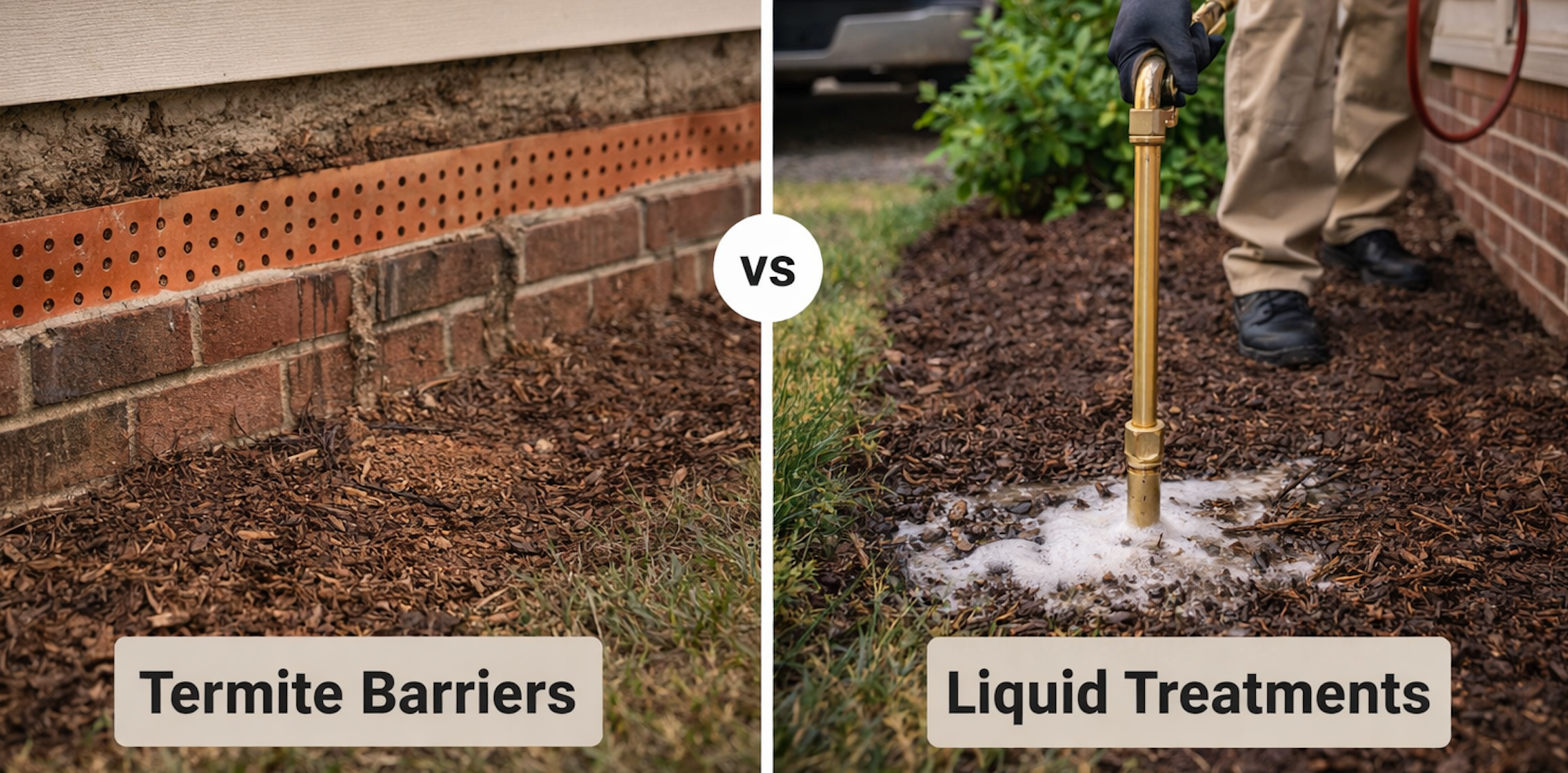
Liquid termite treatment creates a continuous chemical barrier in the soil surrounding a structure’s foundation to intercept subterranean termites before they reach the home. This barrier of protection is established through a strategic application process:
- Trenching: A shallow trench is dug around the exterior perimeter of the foundation.
- Drilling: In areas with concrete—such as garages or porches—small holes are drilled through the slab to reach the soil beneath.
- Injection: High-volume termiticides, such as fipronil or imidacloprid, are applied to the soil and backfilled.
These modern non-repellent liquids utilize a transfer effect, allowing foraging termites to carry the active ingredient back to the central colony. Through grooming and feeding, the treatment spreads throughout the population, leading to the colony’s elimination.
Most professional-grade liquid barriers remain effective for 5 to 10 years, depending on local soil composition and moisture levels. Because the EPA strictly regulates these treatments for safety and performance, they are the most common choice for Maryland homeowners requiring immediate and durable defense.
How Do Termite Bait Barrier Systems Work?
Termite baiting systems utilize a proactive, “search and retrieve” strategy to eliminate subterranean colonies. Rather than creating a chemical barrier, this method uses in-ground stations strategically placed around a home’s perimeter to intercept foraging termites before they reach the structure.
Inside these stations are cellulose materials laced with slow-acting Insect Growth Regulators (IGRs), such as noviflumuron or diflubenzuron. Because these chemicals do not kill immediately, termites consume the bait and return to the colony, unknowingly sharing the treatment with the population.
This method leverages the species’ natural social behavior to achieve complete colony elimination.
Get a Free Quote on Long-Term Termite Control
Liquid Treatment vs. Bait System: Which Is More Effective?
The choice between liquid barriers and bait systems depends on the property’s immediate needs, structural layout, and the homeowner’s preference for long-term maintenance. Both methods are EPA-regulated for safety and are considered highly effective when managed by a professional.
| Feature | Liquid Soil Treatment | Bait Barrier System |
|---|---|---|
| Primary Goal | Immediate structural protection | Total colony elimination |
| Action Speed | Rapid; kills on contact | Slow; relies on growth cycles |
| Invasiveness | Requires trenching and/or drilling | Non-invasive; in-ground stations |
| Environmental Impact | Uses high volumes of termiticide | Targeted, low-chemical approach |
| Best For | Active infestations needing a fast stop | Prevention and long-term monitoring |
While liquid treatments offer a faster “knockdown” of termites entering a home, bait stations are often the preferred solution for properties where trenching is physically impossible or for homeowners seeking an eco-friendly, less-invasive alternative.
Ultimately, the most effective defense in Maryland often involves a site-specific recommendation from a licensed exterminator who can account for localized subterranean pressure.
How Much Does Termite Treatment Cost in Maryland?
The total investment for termite control in Maryland depends on the treatment method, the linear footage of the structure, and the severity of the infestation. Foundation types (such as crawl spaces vs. concrete slabs) and soil conditions also play a critical role in labor and material requirements.
Professional termite remediation typically falls within the following price ranges:
- Liquid Soil Treatments: $500 to $2,500+. This is often a higher upfront cost but provides 5–10 years of continuous protection.
- Bait Barrier Systems: $800 to $3,000+ for initial installation, plus $200 to $500 annually for professional monitoring and bait replenishment.
According to Angi.com, localized data for the Baltimore area indicates that one-time targeted treatments average between $200 and $1,000, while ongoing annual protection plans range from $200 to $400. However, these numbers are only an estimate.
Homeowners should secure a professional on-site inspection to receive a quote tailored to their property’s specific linear footage and foundation requirements.
How Do You Choose a Termite Control Company in Maryland?
Selecting a pest control provider in Maryland requires more than a price comparison; it requires verifying technical expertise and local credentials. Because subterranean termites can cause significant structural damage if a treatment is misapplied, your choice of contractor is as critical as the treatment method itself.
Before hiring, verify the following:
- Active Maryland Pesticide Applicator License: Ensure the company is legally registered with the Maryland Department of Agriculture.
- Experience with Subterranean Termites: Confirm they specialize in the specific biology and behavior of Maryland’s local species.
- Availability of Both Liquid and Bait Options: A reputable firm should offer both industry-standard solutions to provide a recommendation tailored to your specific foundation.
- Clear Warranty Terms and Renewal Conditions: Understand the “termite bond,” including what is covered in the event of a re-infestation.
- Detailed Inspection and Treatment Plan: You should receive a comprehensive graph of your home highlighting active points of entry and the exact application zones.
Whether you opt for the immediate chemical perimeter of a liquid soil treatment or the long-term colony elimination of a bait barrier system, the goal remains the same: neutralizing the subterranean threat before it compromises your home’s integrity.
By prioritizing professional expertise over the lowest bid and understanding the technical nuances of each method, Maryland homeowners can ensure their property remains a secure, termite-free environment for years to come.
FAQs
How much does termite treatment cost in Maryland?
Liquid treatments typically cost $500 to $2,500 for the average home, while bait stations can cost anywhere between $800 and $3,000. Termite treatment cost is determined by the property size and specifics, and the severity of the infestation.
What is the difference between termite bait stations and liquid treatment?
Liquid treatments use special chemicals to create a barrier around the home that kills termites quickly, while bait stations work slowly to eliminate colonies more efficiently. Both are effective, and the right choice is dependent on the circumstances.
How long does a liquid termite treatment last in Maryland?
Most liquid termiticides remain for five to ten years. Soil conditions, heavy rain, and construction can all reduce the lifespan of these treatments.
Does homeowner’s insurance cover termite treatment in Maryland?
No. Standard homeowner insurance policies treat termite damage as a maintenance issue rather than a sudden event, thereby excluding it from coverage. Some pest control companies offer damage warranties as part of their service contracts, which are worth the money in high-risk areas.
How do I know if I have subterranean termites in Maryland?
Mud tubes, hollow-sounding wood, discarded wings near windowsills, or frass (termite droppings) near wood structures are all signs of subterranean termites. An expert inspection is the best way to confirm.
Are termite bait systems safe around children and pets?
Yes. Bait stations are contained in tamper-resistant, in-ground enclosures that hold small amounts of a growth regulator that doesn’t affect mammals the same way it does termites and insects. EPA registration covers residential use around people and pets to verify they’re safe.
How long does bait station treatment take to eliminate a termite colony?
Bait stations typically take three to six months to have a significant impact on a colony, while liquid barriers take days or weeks. This is a major consideration in the debate between termite liquid and bait treatments.
Can I treat termites myself in Maryland?
Yes. DIY termiticide products are available, but applying them correctly requires trenching, drilling, and soil injection at precise intervals. Maryland also requires a commercial pesticide applicator license for certain products, most of which are unavailable to consumers. In short, it’s better to let an expert do the work.
What is a termite bond and do I need one in Maryland?
A termite bond is a service contract that includes ongoing monitoring and treatment if termites return, typically renewing annually. You don’t need one, but for Maryland homes in high-risk areas or previous infestations, a bond serves as documented protection that can help with resale.
Does Maryland require a termite inspection when selling a home?
No. Maryland does not mandate a termite inspection by law. However, most lenders require a Wood Destroying Insect (WDI) report for FHA and VA loans. Buyers also frequently request one where the seller is expected to cover the termite treatment cost.
CTA: Schedule a Termite Inspection Today