

Eliminating ticks from your Maryland property requires a combination of personal inspections, professional barrier treatments, yard modifications to reduce habitats, and regular checks.
Maryland is one of the states with the highest incidence of Lyme disease in the country.
The primary reason is the widespread establishment of Ixodes scapularis, also known as the black-legged tick or deer tick, across all 23 counties and Baltimore City.
Maryland also has documented populations of the American dog tick (Dermacentor variabilis) and lone star tick (Amblyomma americanum), creating tick pressure from spring through late fall.
This guide explains the major tick species found in Maryland and the associated risks. It also walks through how you can reduce tick populations around your home, how to prevent bites, and when professional tick control is worth considering.
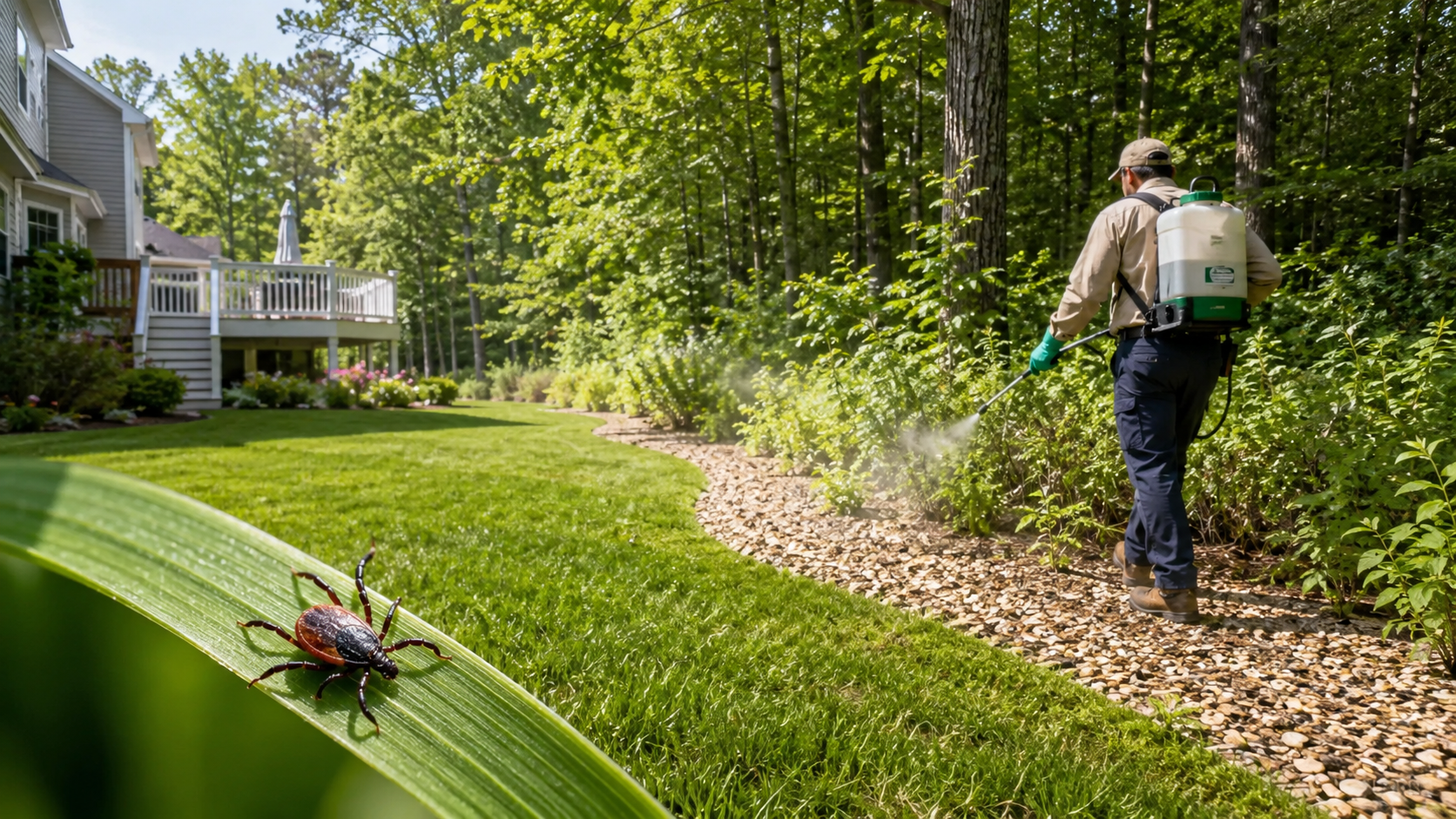
What Ticks Are Found in Maryland?
The most common tick in Maryland is the black-legged tick, but several types of ticks are found throughout the Chesapeake region, spreading several dangerous diseases.
Black-Legged Tick (Deer Tick)
The black-legged tick (Ixodes scapularis), commonly known as the deer tick, is the primary vector of Lyme disease in Maryland and a rare but serious disease known as Powassan virus.
It’s active during cooler periods, typically found from October to May, with peak nymph activity during late spring and early summer.
Deer ticks in Maryland primarily live in wooded areas, leaf litter, and shaded, high-humidity environments. They are established throughout Maryland, making them the most significant tick-borne disease threat to residents.
American Dog Tick
The American dog tick (Dermacentor variabilis) is active during spring and summer. While the name is derived from the fact that this species often feeds on dogs and other pets, it can carry Rocky Mountain spotted fever and tularemia, which pose threats to humans.
Dog ticks prefer areas with moderate vegetation, such as fields and trails. They are much larger than deer ticks and often easier to spot.
Lone Star Tick
The lone star tick (Amblyomma americanum) is active from April to August. This aggressive species is associated with ehrlichiosis and Southern Tick-Associated Rash Illness (STARI).
These ticks are often found in wooded habitats and brush, typically preferring areas with high deer populations.
While other species wait for hosts to pass by, lone star ticks actively seek out humans and animals to feed on.
How to Get Rid of Ticks in Your Yard
To get rid of ticks in your yard, eliminate their preferred habitats by keeping your lawn short, removing debris, and creating dry, sunny environments where ticks cannot survive.
Since tick control in Maryland is an ongoing process, combining habitat reduction with physical barriers is the most effective strategy.
Remove Tick Habitat
All tick species require moisture and shade to survive. Dry, sunny environments are a natural deterrent. Most outdoor living spaces already lean toward the latter.
Still, it’s important to stay on top of these areas to keep populations low.
To reduce tick habitats, implement the following lawn care tips:
- Remove leaf litter from wooded edges.
- Keep grass under 3 inches tall.
- Trim vegetation along fence lines.
- Remove brush piles and yard debris.
- Prune low-hanging branches to increase sunlight penetration.
Create a Tick Barrier
Simple barriers around the property will reduce tick migration into key areas. This can be paired with thoughtful landscaping to keep spaces aesthetically pleasing and enjoyable while creating an obstacle that ticks will struggle to overcome.
These physical barriers include a 3-foot-wide strip of wood chips, gravel, and crushed stone to deter ticks from your property.
Reduce Wildlife Hosts
Ticks rely on hosts to survive throughout their entire life cycle. These hosts can easily transport them to your property.
The primary hosts for deer ticks include:
- White-tailed deer
- White-footed mice
- Small mammals
- Ground-feeding birds
As much as some residents enjoy wildlife, it is important to control their presence to reduce tick populations on their property.
Simple tricks to help with this include:
- Limiting bird feeders near the home
- Cleaning up fallen seed
- Removing rodent harborage
- Securing trash containers
- Eliminating brush piles
Consider Tick Tubes
Tick tubes are a targeted effort to treat rodents that carry immature ticks. These are simple devices that contain treated nesting materials that mice collect. The treatment kills ticks on rodents without harming the animals.
Tick tubes are effective near:
- Stone walls
- Wood piles
- Brush lines
- Woodland edges
Professional Tick Barrier Treatments
Professional tick treatments are recommended for properties with persistent tick activity. Research has shown that properly applied acaricide treatments can reduce tick populations by 68% to 90% when integrated with habitat management practices.
Keep in mind that when treating the entire yard, technicians will target areas where tick populations are concentrated, such as leaf litter, brush lines, and mulch, to achieve the highest success.
How to Prevent Tick Bites on People
The best way to reduce your chances of tick bites is to wear protective clothing when hiking and maintain your landscaping.
Wear Protective Clothing
Reducing skin exposure is a simple but effective way to prevent tick bites. When entering areas where ticks thrive, such as wooded or grassy environments, be sure to:
- Wear long sleeves.
- Wear long pants.
- Tuck pants into socks.
- Choose light-colored clothing to make ticks easier to spot.
Use EPA-Registered Repellents
EPA-registered repellents are a very effective way to reduce tick bites. Clothing and gear can be treated with permethrin products specifically labeled for fabric—never apply permethrin to skin.
Suitable skin repellents include:
- DEET (20% to 30%)
- Picaridin
- IR3535
- Oil of lemon eucalyptus
Stay on Maintained Trails
Simply reducing contact with vegetation reduces opportunities for ticks to attach to you and your pets. Ticks often hide in vegetation along trail edges and in other dense vegetation.
When hiking or walking, be sure to stay in the center of trails and avoid contact with tall grass or brush.
Perform Tick Checks
Even with the best practices in place, physical tick checks are still important. Always conduct a full-body check within two hours of outdoor activity.
Deer ticks need 24-36 hours to transfer Lyme disease, so the faster you spot and remove a tick, the better your chances are of avoiding disease transmission.
Showering within two hours of outdoor activity can wash off unattached ticks. It also doubles as an opportunity to conduct a thorough full-body check.
Does Professional Tick Control Work?
Professional tick control can be highly effective when combined with habitat management efforts. Modern tick control programs focus on perimeter treatments that target critical areas on your property.
Target zones include:
- Vegetation edges
- Leaf litter
- Mulch beds
- Woodland borders
- Brush lines
Professional treatments typically use EPA-registered acaricides. The most effective treatment windows are May for nymphs and September for adults.
It’s important to view professional treatment as a single component of a pest management strategy, not the sole action. Otherwise, the tick population will continue to thrive.
Get My Free Tick Barrier Treatment Quote Today
FAQs
How do you get rid of ticks in your yard?
Effective yard tick control combines habitat modification, host management, and professional treatments. Removing litter, mowing grass regularly, clearing brush, and establishing physical and treated perimeters can significantly reduce tick populations.
What kind of ticks are in Maryland?
Maryland has three medically significant tick species: the black-legged tick (deer tick), American dog tick, and lone star tick. The deer tick is the primary vector of Lyme disease and is established statewide.
How do you remove a tick properly?
Use fine-tipped tweezers, grasp the tick as close to the skin as possible, and pull upward with steady pressure. Clean the area afterward. Do not use petroleum jelly, nail polish, or heat.
How long does a tick have to be attached to transmit Lyme disease?
Lyme disease transmission typically requires 36 to 48 hours of attachment by an infected black-legged tick. This is why prompt removal substantially reduces transmission risk.
Does DEET repel ticks?
Yes. DEET products containing 20-30% of the active ingredient provide effective tick repellency. Combining them with permethrin-treated clothing provides additional protection, but thorough checks are still important.
What attracts ticks to a yard?
Ticks thrive in moist, shaded environments with access to hosts. Leaf litter, tall grass, brush piles, wooded edges, deer activity, and rodent populations all contribute to higher tick densities. Simple habitat control methods can help limit populations.
What tick-borne diseases are found in Maryland?
Tick-borne diseases in Maryland include Lyme disease, Rocky Mountain spotted fever, ehrlichiosis, anaplasmosis, Powassan virus disease, and Southern Tick-Associated Rash Illness (STARI). Lyme disease remains the most commonly reported with the primary vector (deer ticks) being established statewide.
Is professional tick control worth it?
Yes. Professional tick control is worth it for properties with wooded edges, frequent tick encounters, or high outdoor activity levels. The best results are achieved when treatment is paired with habitat modification and personal protection practices.