

The Sentricon System is a termite baiting program that eliminates the entire subterranean termite colony attacking your home, including the queen, instead of just laying down a chemical barrier the termites have to bump into. Stations installed in the soil around the house hold a bait that worker termites prefer to wood. They carry it back, share it, and the colony collapses over the following weeks and months.
For Maryland homeowners, that matters because the Eastern subterranean termite is the state’s most damaging structural pest, it works out of sight, and it never really stops. This guide explains how Sentricon works, how it compares to a liquid termiticide treatment, why Maryland homes are exposed, what it costs, and how the ongoing protection works.
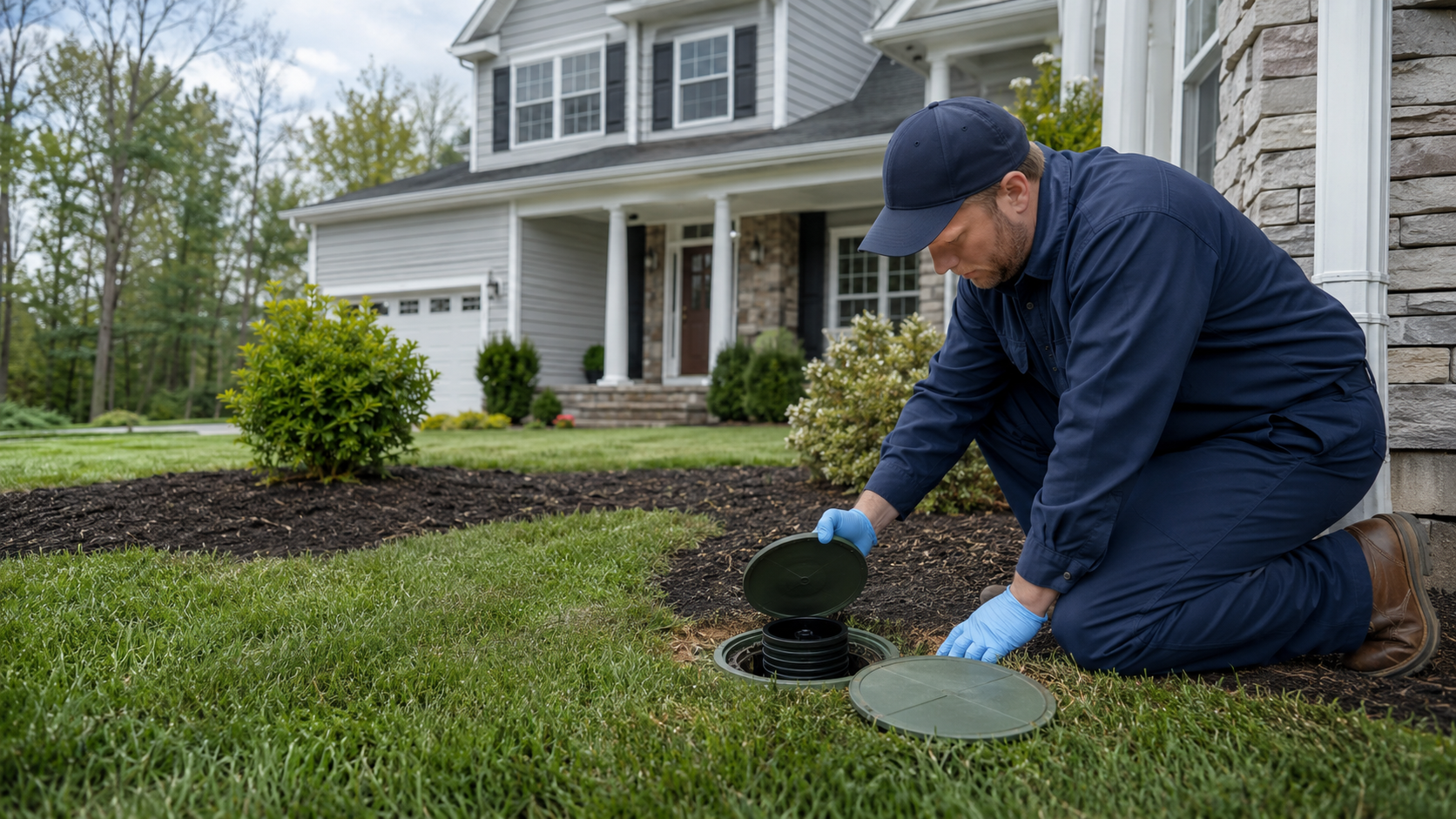
How Does the Sentricon System Work?
Sentricon takes advantage of how termites feed. Worker termites forage through the soil for cellulose and share what they find with the rest of the colony, including the reproductives. According to the Sentricon System manufacturer, the system is designed to eliminate the whole subterranean colony, queen included, and can be installed both to eliminate an active infestation and to prevent one.
- Stations go in the ground around the perimeter. A certified technician installs discreet in-ground stations at intervals around the foundation, in the soil where termites forage. Nothing is drilled into the slab or pumped under the house.
- The bait is more attractive than wood. Each station holds a cellulose bait containing noviflumuron. Foraging workers find it, feed, and carry it back to the colony, where it is passed from termite to termite.
- It stops termites from molting. Noviflumuron is a chitin synthesis inhibitor. Termites have to molt to grow, and workers that have fed on the bait cannot complete the molt. Because it acts slowly, affected workers keep sharing the bait before they die, so it reaches deep into the colony rather than killing a few termites at the station.
- The colony collapses. As workers die off, the colony can no longer feed its soldiers, young, or queen, and it is eliminated. The process typically plays out over weeks to months, which is why this is a program rather than a one-day treatment.
- Always Active keeps the bait in place. With Always Active technology, every station is loaded with bait from day one, so termites that arrive later start feeding immediately. Stations are inspected and serviced on a schedule to keep the protection continuous.
Sentricon is only available through trained, certified pest control companies. Pest Czar installs and services the system across the Baltimore metro.
Sentricon vs. Liquid Termiticide: Which Is Right for Your Home?
Both approaches are used by professionals and both can protect a home. The difference is in what they target and what they ask of your property.
| Factor | Sentricon baiting | Liquid termiticide barrier |
|---|---|---|
| What it targets | The colony itself; workers carry bait home and the colony is eliminated | Termites that contact treated soil around the structure |
| Installation | In-ground stations placed around the perimeter; no trenching or drilling | Trenching along the foundation and often drilling through slabs, patios, and garage floors |
| Chemical volume | Small amount of solid bait sealed inside stations | Hundreds of gallons of diluted termiticide applied to soil |
| Impact on landscaping | Minimal; stations sit flush with the ground | Trenches through beds and around hardscape |
| Speed | Colony elimination over weeks to months; feeding on the structure declines as workers die | Fast kill of termites that cross the barrier |
| Gaps in protection | Stations are checked and serviced; coverage is continuous with Always Active | Barrier can be broken by settling, digging, new hardscape, or gaps in application |
| Rowhomes and shared walls | Limited on attached homes; Above-Ground stations can target interior activity | Often the practical option for rowhomes where perimeter access is shared |
| Long-term model | Ongoing monitoring program with scheduled service | Retreatment when the barrier degrades, typically after several years |
For most detached Maryland homes, Sentricon delivers colony elimination with far less disruption to the house and yard. For attached rowhomes, where you cannot control the shared perimeter, a liquid treatment or Above-Ground stations placed at interior activity may be the better fit. An inspection settles which one your home needs.
Why Do Subterranean Termites Threaten Maryland Homes?
The Eastern subterranean termite is the dominant termite species in Maryland and the one responsible for nearly all structural termite damage here. The University of Maryland Extension describes how these colonies operate: workers carry food back to the immatures and reproductives, soldiers defend the colony, and mature colonies periodically release winged reproductives called swarmers, whose flights or piles of shed wings are often the first sign a homeowner ever sees.
Three traits make them dangerous to a house:
- They are hidden. Subterranean termites tunnel inside wood and leave the outer shell intact, so a joist or sill plate can look normal while it is hollow. UMD Extension notes that even very active infestations are hard to detect, and damage often accumulates for years before anyone notices.
- They come from the soil. Colonies live underground and reach the house through mud shelter tubes, about a quarter inch wide, on foundations and exposed wood. Maryland’s moist, clay-heavy soils and humid summers suit them, and mild winters mean colonies stay active year-round.
- They swarm in spring. Eastern subterranean termites typically swarm from early spring into early summer in Maryland, often after warm rain. Swarmers indoors mean an established colony is in or under the house. UMD Extension advises a professional inspection whenever you find shelter tubes, soil packed in cracks, or piles of silvery quarter-inch wings.
Termite damage is rarely covered by homeowners insurance, and industry estimates put U.S. termite damage in the billions of dollars each year. If you are trying to identify what you are seeing, start with our guides on what to do about termite swarmers and the 10 signs you have termites, or our homeowner’s guide to subterranean termites. This post is about the fix.
What Does Sentricon Cost in Maryland, and How Does It Bundle?
Pricing starts with an inspection. Pest Czar’s termite inspection is $65, and that fee is credited toward your treatment if termites are found. The inspection tells us whether you have an active colony, where termites are entering, and whether your home is a fit for in-ground stations, Above-Ground stations, or a liquid treatment. From there, you receive a quote for ongoing protection sized to your property.
Sentricon is sold two ways. You can purchase it as a stand-alone termite program, or bundle it with any Czar Guard plan at a discounted rate. Czar Guard plans start at $39 per month for exterior pest protection, $49 with interior coverage, and $75 for specialty pests, and adding Sentricon to any of them costs less than buying the two separately. For a homeowner who wants termites, ants, rodents, and stinging insects handled under one plan with one technician, the bundle is the simplest route.
Two honest notes on fit. Sentricon’s in-ground program is designed for detached homes where the full perimeter can be treated. For rowhomes and attached properties, we typically recommend a liquid treatment or Above-Ground stations placed at interior termite activity. And because subterranean termites are permanent residents of Maryland soil, Sentricon is priced as a continuing service rather than a one-time job; stopping the service ends the protection.
How Does Ongoing Monitoring and Protection Work?
Termite pressure in Maryland does not end when one colony is eliminated. New colonies forage through the same soil, and swarmers land new queens every spring. Sentricon is built for that reality.
- Scheduled station service. With Always Active, stations stay baited at all times and, in most cases, can be inspected and serviced from the exterior twice a year, with no need to schedule access inside the home.
- Documented activity. Each service visit records which stations show feeding, so you have a running picture of termite pressure around your property rather than a single snapshot.
- Fresh bait and replacement. Stations that have been fed on are rebaited, and damaged or displaced stations are replaced, so the perimeter never has a dead spot.
- Coverage for new colonies. Because bait is always present, a colony that moves into the area starts feeding on it before it reaches the structure. That is the difference between preventing an infestation and discovering one.
Homeowners on Czar Guard can pair this with quarterly general pest service and the Pest Czar Guarantee, so termite protection and everyday pest control run on the same schedule.
Is Sentricon Safe for Kids, Pets, and Gardens?
The design addresses the concerns most families raise. The active ingredient works by disrupting termite molting, a process that people and pets do not have, and it is delivered as a small amount of solid bait sealed inside locked stations set in the ground rather than sprayed or pumped around the house. There is no trenching through garden beds and no drilling through patios, so lawns, plantings, and hardscape are left alone. The system received the U.S. Environmental Protection Agency’s Presidential Green Chemistry Challenge Award in 2000 for that lower-impact approach.
If you have seen swarmers, shed wings, or mud tubes, or you simply want your Maryland home protected before termites find it, contact us to schedule a $65 inspection. Pest Czar is a woman-owned, QualityPro and GreenPro-certified exterminator based in Towson and a trained Sentricon provider serving the Baltimore metro.
FAQs
What is the Sentricon System?
A professional termite baiting program. Stations installed in the soil around a home hold a cellulose bait containing noviflumuron. Foraging termites eat it and share it with the colony, which prevents workers from molting and eliminates the colony, including the queen, over the following weeks and months.
How long does Sentricon take to kill a termite colony?
Colony elimination typically takes weeks to a few months, depending on colony size and how quickly workers find and feed on the stations. Feeding on the structure declines as workers die off. The slow action is intentional, because it lets affected termites keep spreading the bait through the colony.
Is Sentricon better than a liquid termite treatment?
For most detached homes, yes: it eliminates the colony rather than blocking termites at a barrier, uses far less pesticide, and requires no trenching or drilling. Liquid treatments still make sense for attached rowhomes and some construction types. A professional inspection determines the right fit.
Does Sentricon prevent termites or only treat them?
Both. Because Always Active stations are baited at all times, new colonies that forage near the home start feeding on bait before they reach the structure. Many Maryland homeowners install it preventively after a clean inspection.
How much does Sentricon cost in Maryland?
Pest Czar’s termite inspection is $65, credited toward treatment if termites are found, and the Sentricon program is then quoted for your property. It is available as a stand-alone service or at a discount when bundled with a Czar Guard pest control plan.
Can Sentricon be used on a rowhome?
The in-ground program is designed for detached homes with a treatable perimeter. For rowhomes and attached properties, Pest Czar typically recommends a liquid treatment or Above-Ground Sentricon stations placed where interior activity is found.
Is Sentricon safe around children and pets?
The bait is a small amount of solid material sealed inside locked in-ground stations, and its active ingredient targets the termite molting process, which people and pets do not have. The system received the EPA’s Presidential Green Chemistry Challenge Award in 2000 for its reduced-impact design.
How often are Sentricon stations checked?
With Always Active technology, stations can be inspected and serviced about twice a year in most cases, usually from the exterior. Stations with feeding activity are rebaited and any damaged stations are replaced.
What are the signs I need termite treatment in Maryland?
Swarms of winged termites or piles of shed wings indoors in spring, pencil-width mud tubes on the foundation or exposed wood, soil packed into cracks, and wood that sounds hollow or shows blistered paint. The University of Maryland Extension recommends a professional inspection for any of these.
Does homeowners insurance cover termite damage?
Usually not. Most policies treat termite damage as preventable, gradual deterioration and exclude it, which is why ongoing termite protection is worth more than it costs for homes in Maryland’s termite-prone soils.